
Cellstat a low-cost potentiostat
January 2023 - May 2025
Objective
The goal of this project was to design a fully functional and low-cost potentiostat for liquid battery and electrochemical research. Traditional lab-grade potentiostats often cost upwards of $10,000, which limits accessibility for smaller labs and student researchers. My aim was to develop a compact, affordable system—without compromising measurement precision—that could support a range of testing needs, including spectroscopy integration.
View Thesis on Concordia Spectrum
Images



Project Contributions
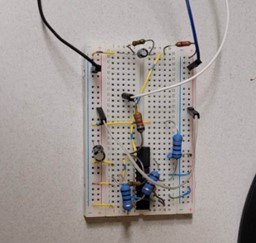
This project was the focus of my master’s thesis and involved developing a custom potentiostat system from the ground up. I successfully reduced the total cost of the device from $10,000 to under $200 by designing a compact, optimized PCB and sourcing cost-effective components. The system was built to support techniques like cyclic voltammetry (CV) and chronoamperometry while maintaining accuracy in the nanoampere to milliampere range.
I designed the analog circuitry for voltage control and current measurement, implemented firmware for microcontroller-based data acquisition, and built a custom Faraday cage to reduce electromagnetic interference during testing. To ensure compatibility with ongoing research, I worked closely with other researchers to explore how the system could be paired with spectroscopy setups for advanced analysis.
Skills and Technical Details Gained
- Gained deep experience in analog circuit design, signal processing, and electrochemical system architecture.
- Learned how to program microcontrollers for real-time data acquisition and serial communication.
- Designed and fabricated custom PCBs, focusing on trace layout and filtering for noise reduction.
- Worked in a multidisciplinary environment combining electronics, chemistry, and software development.
- Learned how to use C++ to optimize my low-level firmware.
- Gained experience in Python QT for creating graphical user interfaces to visualize potentiostat readings.
This project reinforced my ability to analyze, design, and validate mechanical systems while considering real-world constraints such as cost, safety, and manufacturability.