
Rover Suspension Device
September 2024 - October 2024
Objective
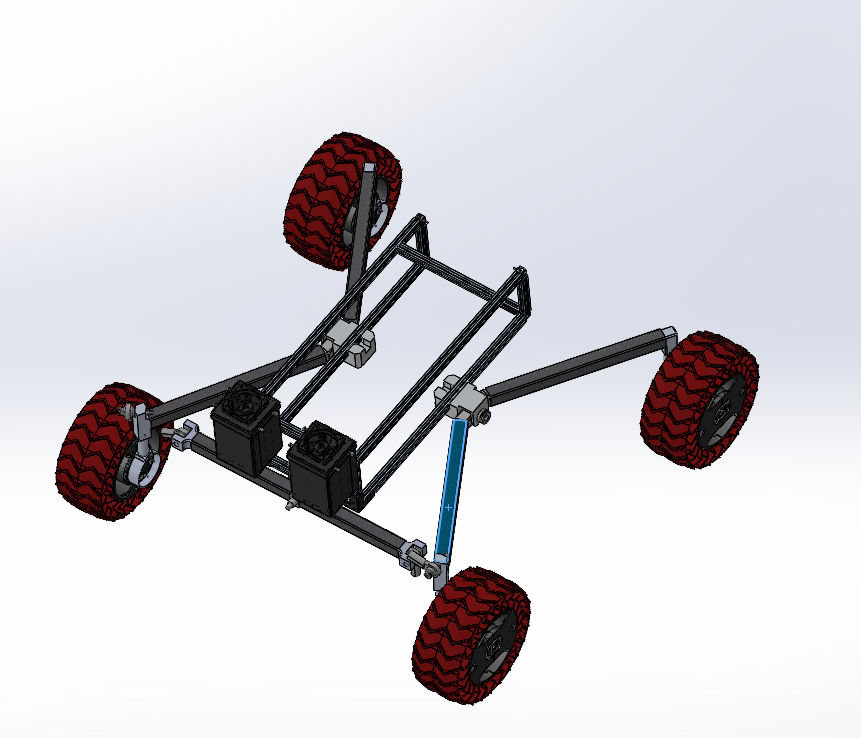
The goal of this project was to develop a passive suspension system to improve the terrain traversal capabilities of Mars-like rovers. The focus was on creating a reliable rocker-bogie system that could maintain stability and minimize stress across all wheels while navigating steep slopes, rocks, and loose surfaces—particularly for application in the University Rover Challenge.
Project Contributions
As part of Space Concordia Robotics, I worked on the mechanical design of a 4-wheel rocker-bogie suspension system aimed at enhancing our rover’s mobility over rough terrain. The system was designed for passive operation to minimize complexity and reduce maintenance during field operation. I conducted extensive research into rocker-bogie geometries, force balancing, and mechanical simplification techniques, including how linkages transfer loads during incline traversal and obstacle climbing.
While the project was not carried through to fabrication due to resource limitations, it provided a strong learning experience and shaped my approach to mechanical problem-solving in robotics. I gained valuable experience in system-level thinking, force distribution, and terrain-aware design.
Images

Skills and Technical Details Gained
- Gained experience in suspension system kinematics and the tradeoffs in passive vs. active mobility systems.
- Learned how to run preliminary force and stress evaluations using FEA tools for terrain loading scenarios.
- Improved my understanding of design constraints in rover-scale mechanical systems.
- Applied structural analysis concepts to early-phase component sizing and material choice.
- Developed a practical understanding of designing for stability and ground contact in uneven terrain.
Even though the rocker-bogie suspension wasn't prototyped, it taught me the importance of mechanical reliability, force modeling, and planning for real-world limitations in robotics design.